
Table of Contents
- 1.Understanding the Legislative Framework Behind Bill 44
- 2.Proximity to Transit: The Distance Rules That Matter
- 3.Lot Dimensions, Assemblages, and Physical Requirements
- 4.Navigating Municipal Bylaws in the City Versus the District
- 5.Economic Realities: Construction Costs, Fees, and Land Value
- 6.Evaluating Your Next Steps as a North Vancouver Homeowner
- ↳Do all detached lots in North Vancouver automatically qualify for a fourplex under Bill 44?
- ↳How do I know if my property is within a transit-oriented area?
- ↳Is it better to sell my North Vancouver home as-is or wait for a developer?
- ↳What are the primary municipal hurdles when building a multiplex?
- ↳How have property values changed for lots with multiplex potential?
North Vancouver Bill 44 Multiplex Zoning Lots: What Homeowners Need to Know
The landscape of the North Shore is undergoing its most significant legislative shift in decades. If you own a detached house in [LINK:north-vancouver], your property might hold a very different kind of value today than it did last year. The provincial implementation of legislation targeting transit-oriented areas has suddenly placed North Vancouver Bill 44 multiplex zoning lots at the center of local real estate conversations. Homeowners across districts like lonsdale">Central Lonsdale, Delbrook, and Lynn Valley are looking at their older single-family parcels with a fresh perspective, wondering if their land now qualifies for multi-unit development. Understanding these rules requires looking past the political headlines and examining the precise municipal guidelines, lot dimensions, and infrastructural realities that dictate what you can actually build on the North Shore.
As a REALTOR® working daily across the North Shore through Royal LePage Sussex, I spend a lot of time helping property owners unpack what these zoning changes mean for their long-term equity. The shift is not a blanket green light to bulldoze every older home, but rather a carefully calibrated framework designed to increase housing density near transit corridors. If you are sitting on a detached property, the key to unlocking its potential lies in understanding the precise intersection of provincial mandates and municipal bylaws. Let us look at how these rules apply on the ground across North Vancouver neighbourhoods.
| Lot Type / Distance | Allowable Units | Max Density (FSR) | Parking Requirements | Development Feasibility |
|---|---|---|---|---|
| Standard Single-Family Lot (< 4,359 sq ft) | 3 to 4 Units | 0.80 – 1.0 FSR | 0.5 – 1 stall per unit | Best for stacked fourplex or duplex with secondary suites |
| Medium Lot (> 4,360 sq ft, non-transit) | 4 Units | 1.0 – 1.2 FSR | 0.5 stalls per unit | Strong feasibility for strata-titled fourplex development |
| Transit-Adjacent Lot (< 400m to Rapid Transit) | Up to 6 Units | 1.5 – 1.8 FSR | Zero minimum parking required | Highest land-lift potential, ideal for multi-unit townhomes |
Understanding the Legislative Framework Behind Bill 44
To grasp what makes certain properties viable, I first need to look at what the legislation actually mandates. Bill 44 fundamentally alters single-family zoning by requiring municipalities to permit small-scale, multi-unit housing—often referred to as SSMUH—on lots previously reserved for single detached homes or duplexes. In municipalities with populations over a certain threshold, which includes both the City of North Vancouver and the District of North Vancouver, single-family zones must now accommodate triplexes, fourplexes, or townhomes depending on lot size and proximity to designated transit hubs.
However, provincial legislation sets the floor, not the ceiling. Local governments retain the authority to shape how these multiplexes look through design guidelines, setback requirements, parking minimums, and tree protection bylaws. This means that while your property may qualify under broad provincial strokes, local municipal red tape will ultimately dictate your building envelope. Navigating this dynamic requires patience and a clear-eyed view of how municipal planners interpret provincial statutes. This leads directly to the question of proximity, which is the primary filter for determining your property's tier of allowable density.
Proximity to Transit: The Distance Rules That Matter
The biggest factor separating a standard single-family lot from a high-density multiplex site is geography. Under the provincial guidelines tied to Bill 44, density allowances scale based on how close a property is to designated transit-oriented areas—specifically, frequent bus exchanges, the SeaBus terminal, or planned rapid transit corridors. If your detached home sits within a specified radius of a transit hub, your property falls into a higher-tier density category that permits greater floor space ratios and more units.
In practical terms, properties closer to the Lonsdale Quay exchange or major rapid bus lines along Marine Drive and upper Lonsdale enjoy the most relaxed density caps. Conversely, properties situated further up the mountain in areas like [LINK:deep-cove] or upper Capilano often face different restrictions, sometimes falling outside the strict transit-oriented zones that mandate multiplex allowances. Even within these zones, specific lot geometry acts as the ultimate gatekeeper for what you can physically construct. Let us examine the physical parcel requirements next.
Lot Dimensions, Assemblages, and Physical Requirements
Having the right zoning designation is only half the battle; your land needs to accommodate the physical structure. Historically, North Vancouver residential lots vary wildly in size, shape, and topography. Standard older lots in flat areas of [LINK:blueridge] or Grand Boulevard may offer clean, rectangular footprints ideal for a side-by-side triplex or fourplex, while sloping lots in Edgemont or Canyon Heights present unique engineering challenges.
Municipalities look closely at lot frontage, depth, and total square footage. While Bill 44 aims to permit multiplexes on smaller standard lots, practical construction constraints often favor lot assemblies—where two or more adjacent homeowners combine their properties to create a larger, unified development site. Assembling lots allows developers and homeowners to maximize floor space ratios, accommodate required off-street parking, and design functional shared outdoor spaces that meet municipal design panels' expectations. If your individual lot is narrow or steeply sloped, retaining a local civil engineer early in the process is essential to determine whether a multiplex is physically feasible.
Navigating Municipal Bylaws in the City Versus the District
One of the most common points of confusion for local homeowners is the administrative division between the City of North Vancouver and the District of North Vancouver. While both municipalities are subject to the same provincial pressure under Bill 44, their implementation timelines, local zoning bylaws, and bureaucratic processes differ significantly. The City, being more compact and urbanized, has historically moved swiftly to adapt its Official Community Plan to align with transit-oriented development.
The District, on the other hand, covers a vast geographic area stretching from urbanized town centers up to the mountain slopes. Consequently, District planners must balance the provincial mandate for density with long-standing neighborhood character concerns, steep slope development permits, and wildfire interface regulations. Understanding which municipality your property falls under dictates your interaction with the planning department, your application fees, and the specific design guidelines your architect must follow. Once you establish your municipality, the financial calculus of development comes into focus.
Economic Realities: Construction Costs, Fees, and Land Value
Developing a detached lot into a multiplex is a commercial venture, even if you are a homeowner hoping to stay on the land through a co-ownership model. The financial equation involves balancing current land value, demolition costs, municipal development cost charges, servicing upgrades, and modern construction expenses. On the North Shore, framing costs, excavation in rocky soil, and strict energy-step-code requirements mean that building multi-family units requires substantial capital.
When evaluating whether to sell your land to a developer or undertake the project yourself, you must look at current market comparables. In many North Vancouver neighborhoods, older homes sitting on large lots are increasingly valued based on their land assembly potential rather than the condition of the 1960s house sitting on top of them. However, construction financing has grown more complex with fluctuating interest rates, making a rigorous feasibility study indispensable before submitting any permits to the city hall.
Evaluating Your Next Steps as a North Vancouver Homeowner
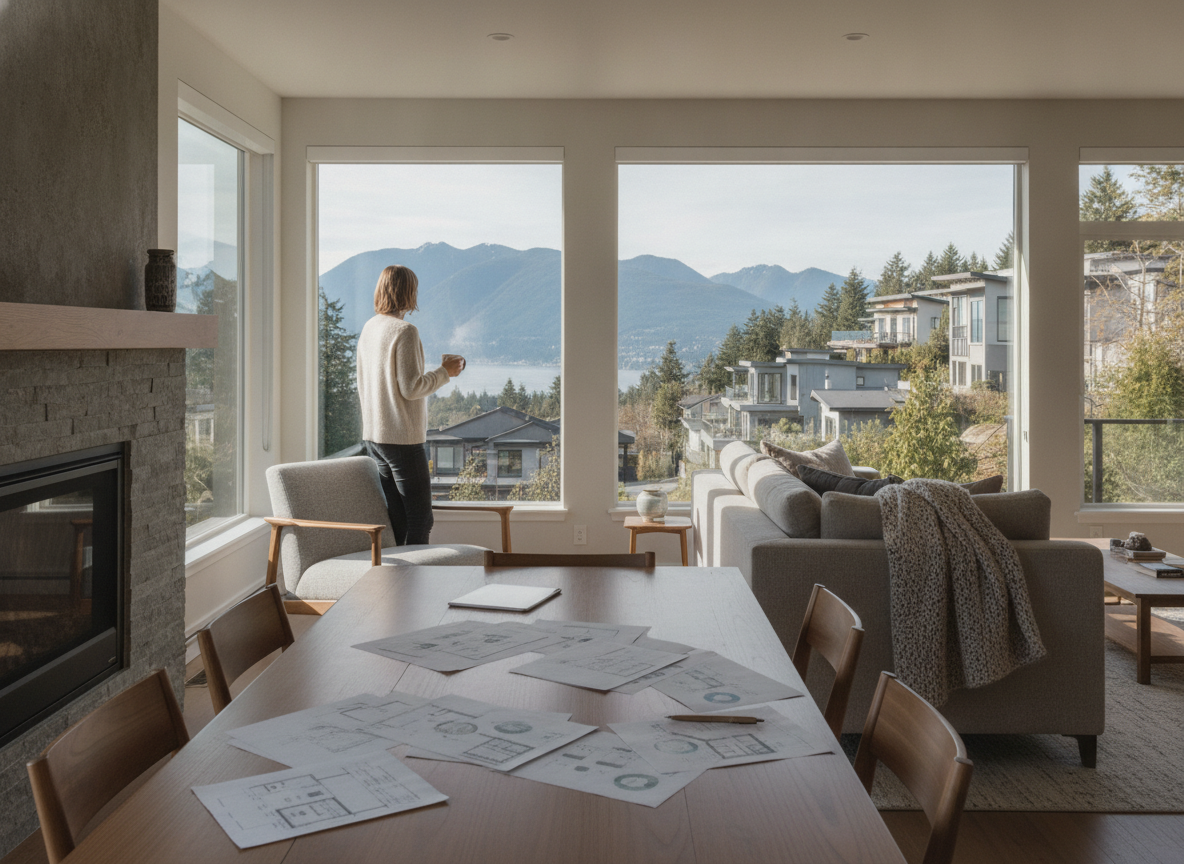
Deciding what to do with a property affected by these new zoning laws requires a personalized strategy. For some homeowners, the best path is simply holding the asset as builders and investors increasingly scour the North Shore for viable land assemblages. For others, partnering with a builder or taking on a phased redevelopment offers a way to capture significant equity without necessarily leaving the neighborhood.
Because every street, lane, and zoning overlay is unique, generalized advice rarely suffices when evaluating real estate potential. If you want a clear, data-driven assessment of your property's current standing under provincial legislation, I invite you to reach out for a tailored property consultation. You can request a detailed home evaluation directly at [LINK:home-valuation] or connect with me through my contact page at [LINK:contact] to discuss your specific real estate goals.
Do all detached lots in North Vancouver automatically qualify for a fourplex under Bill 44?
No. While the legislation establishes a baseline for multiplex permissions, qualification depends heavily on lot size, exact distance from designated transit-oriented areas, municipal bylaws, and physical constraints like slopes or servicing availability.
How do I know if my property is within a transit-oriented area?
Transit-oriented areas are mapped based on specific radiuses around designated transit hubs, such as exchange stations and rapid bus corridors. You can check municipal GIS maps for the City or District of North Vancouver or consult with a local real estate professional to verify your exact zoning tier.
Is it better to sell my North Vancouver home as-is or wait for a developer?
This depends on current market demand in your specific neighbourhood, your personal timeline, and the capital gains tax implications of selling versus developing. Properties packaged together in land assemblages often command higher premiums from active developers.
What are the primary municipal hurdles when building a multiplex?
Key hurdles include meeting strict off-street parking requirements, satisfying tree protection bylaws, adhering to local design guidelines, and upgrading aging municipal water and sewer services to handle increased density.
How have property values changed for lots with multiplex potential?
Properties with high development potential, particularly those in transit-oriented zones or suitable for assemblages, have seen increased interest from builders, shifting valuation metrics away from the physical house and toward the underlying land's developmental capacity.
Navigating the shifting rules of North Vancouver real estate requires local insight and careful planning. Whether you are curious about the development potential of your current property or looking to buy into the North Shore market with an eye on long-term equity, I am here to help you make informed decisions. Reach out to me directly at [LINK:contact] or request a customized property assessment via [LINK:home-valuation?source=ai_blog_cta] to get started.
Want to assess the Bill 44 multiplex development potential of your specific lot? Request an exact land-use analysis for your property.
Have a question about a specific North Shore street or building? Contact Alex Mackenzie directly.
Have questions about the Investment?
Ask a specific question below or request a callback — it goes to Alex directly.
Alex Mackenzie
Royal LePage Sussex · North Vancouver REALTOR®
Alex Mackenzie is a licensed REALTOR® with Royal LePage Sussex, serving buyers and sellers across the North Shore. Royal LePage Top 2% nationally (Diamond Award) and Medallion Club member based on 2025-2026 performance.

